Abdul El-Sayed’s Michigan Senate race could make US history
The US Senate race in Michigan has drawn national and international attention, with Democratic candidate Abdul El-Sayed facing Republican Mike Rogers in a contest that could make El-Sayed the first Muslim senator in American history.
The 42-year-old El-Sayed, a physician and progressive politician, is challenging 63-year-old Rogers, a former congressman and FBI agent, for the seat being vacated by retiring Democratic Senator Gary Peters.
The contest has emerged as a major political battleground in Michigan, a key swing state where Democrats and Republicans have traditionally faced close electoral competition.
El-Sayed’s campaign has attracted particular attention because of his Muslim identity and progressive policy positions. He has faced criticism from Republicans and President Donald Trump over his religious background, as well as his views on Israel, Gaza and US foreign policy.
Progressive Democrat gains momentum
El-Sayed, whose father is an Egyptian immigrant, is a Michigan-born physician who has worked with American institutions and international academic centres. He is widely regarded as part of the progressive wing of the Democratic Party.
In August 2026, he won the Democratic Senate primary, becoming the party’s first Muslim nominee for the US Senate.
His primary victory was significant given that his rival, Haley Stevens, had received backing from several influential Democratic leaders. El-Sayed, meanwhile, secured support from prominent progressive politicians, including Senator Bernie Sanders and Representative Alexandria Ocasio-Cortez.
His campaign has centred on progressive policies, including calls to end US military aid to Israel.
These positions have drawn criticism from some Jewish Democrats and pro-Israel groups, which have accused him of antisemitism. El-Sayed has rejected the allegations.
Religious identity and foreign policy in focus
El-Sayed’s Muslim identity has remained a prominent issue throughout the campaign, with opponents repeatedly targeting his religious background and political positions.
His stance on Israel and the Gaza conflict has also become a major point of contention, particularly his support for ending American military assistance to Israel.
The race has consequently become a closely watched contest over religious representation and the direction of the Democratic Party’s foreign policy.
No Muslim has ever been elected to the US Senate, making El-Sayed’s candidacy particularly significant for Muslim representation in American politics.
Unexpected setback in final campaign stretch
El-Sayed faced an unexpected political setback in the final phase of the campaign when Stevens, his rival in the Democratic primary, announced her support for Republican candidate Rogers.
Rogers, a former US congressman and FBI agent, has previously contested a Senate election in Michigan. His campaign represents a potential Republican pickup opportunity in a state that has remained competitive between the two major parties.
Despite the setback, El-Sayed had maintained a strong position in several pre-election polls.
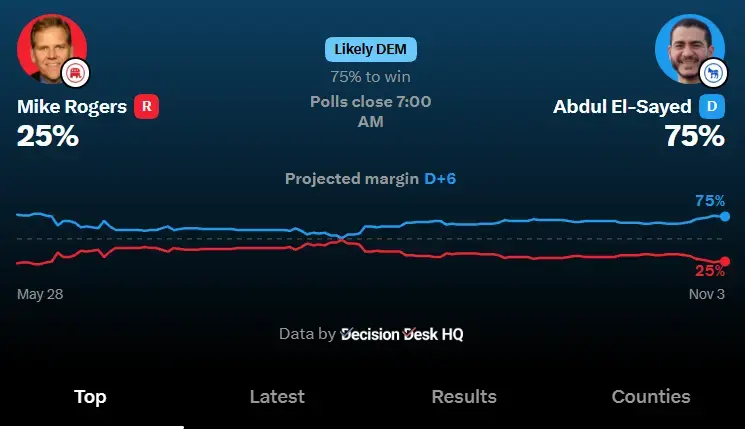
Election analysis firm Decision Desk HQ gave him a 75% chance of winning the race, while other surveys had also shown him with a narrow or substantial lead.
The outcome could have implications beyond Michigan, potentially reshaping the Senate’s political balance while marking a historic milestone for Muslim representation in the United States.
If El-Sayed defeats Rogers, he will become the first Muslim elected to the US Senate.