
US Treasury yields hit 24-year high as global bond selloff deepens
Global bonds were engulfed by heavy selling again on Thursday, sending borrowing costs from the US to France and Japan surging to levels not seen in decades in a warning to policymakers.
Higher rates raise financing costs for companies and mortgage borrowers and force governments to spend more on interest payments, with less left over for anything else.
Bond yields, which rise when prices fall, have soared globally as soaring energy costs fan inflation. The boom in artificial intelligence and data-centre building have heightened competition for capital and raised expectations about economic growth and where short-term interest rates will settle.
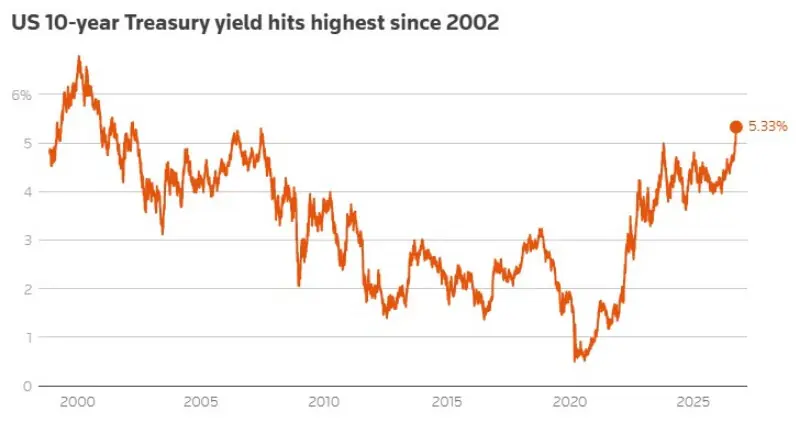
The US 10-year Treasury yield, a yardstick for global borrowing costs and asset prices, rose to 5.34%, its highest since 2002, on Thursday, having posted its biggest quarterly rise this century in the three months to September.
And while dip buyers are stepping in, with the global benchmark last around 5.32%, there could still be scope for further moves.
“Financial markets are in the midst of a discovery process to see where the new long-term anchor sits,” said HSBC’s chief Asia economist Fred Neumann.
Markets were responding to years of above-target inflation, he said and “until monetary tightening is delivered, bond markets will demand a premium for longer-term borrowing.
“But it would be unfair to lay the blame entirely on central bankers: in the end, it is expansionary fiscal policies that are equally to blame for persistent inflation.”
FRANCE IN FOCUS
France is near the top of bond investors’ minds. Its government is presenting a 2027 budget bill on Thursday which could struggle to get unpopular belt-tightening measures through parliament.
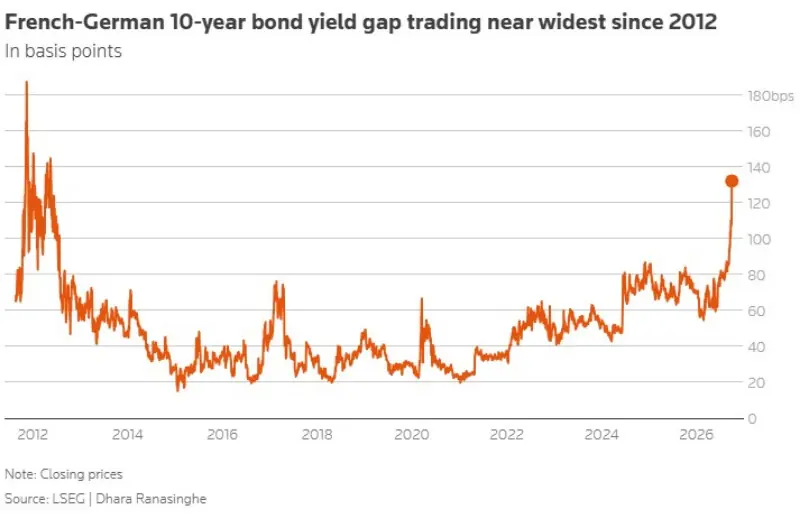
In a sign of the challenge, French 10-year borrowing costs also hit their highest since 2002 on Thursday, trading close to the symbolic 5% level after turning in its worst quarterly performance since 1987 between June and September.
While French yields also retreated from their early highs, the gap between French and German 10-year borrowing costs is at its highest since the euro zone debt crisis of the 2010s, and the cost of insuring France’s debt against the risk of default is at its highest since 2013.
GLOBAL PRESSURE
The European Central Bank is even facing questions about whether it might help shore up France’s bond market, though market players say this seems unlikely for now.
For sure, the upward pressure on yields and hence government finances, is global.
The Washington-based Institute of International Finance recently estimated that over the past year, advanced economies paid more than $3.3 trillion in interest on internationally traded government bonds alone — more than the estimated $2.6 trillion of global spending on AI, $3.1 trillion on defence or $2.3 trillion on clean energy.
Britain’s 30-year government bond yield rose above 6% to its highest since 1998 on Thursday, and data showing the slowest growth in house prices in nearly two years pointed to the impact of higher rates on the real economy.
In Japan, where inflation is taking hold after a decades-long battle with deflation, sovereign yields have notched an unprecedented fifth consecutive quarter of double-digit gains.
STOCKS HOLD UP FOR NOW
Good economic growth data globally is also part of the picture. Factory activity across Europe and Asia expanded last month, helped by AI related investments, giving central banks little reason to worry about the consequences of tightening policy.
“Stronger growth has encouraged markets to conclude that the economy can sustain higher rates for longer,” said Julius Baer fixed income analyst Afonso Borges.
Traders have scrambled to reverse earlier expectations for US interest rate cuts this year. After a hike last month, they now expect at least three more Federal Reserve hikes before the middle of 2027, even if cooler inflation data on Wednesday helped push back near-term expectations.
European inflation data this week has been hotter than expected, though, while the European Central Bank has raised rates twice this year and markets price three further 25-basis-point increases by mid-2027.
But while assets from stocks to credit were jittery on Thursday, the selling was far from that seen in bonds.
European stocks hit their lowest since June but were last down just 0.5%, while US stocks are set to open higher.
In credit markets, an index of junk bond credit default swaps, which protect against the risk of default, hit its highest since early April.
“I don’t think we’re necessarily yet at the point where higher rates can act as a showstopper,” said Chris Scicluna, head of economic research at Daiwa Capital Markets.
“There’s a lot of news out there still about earnings, and there’s a lot of positive momentum still to come through from AI-related investments over the next couple of quarters.”